


By Alina Karabchevsky, PhD
Ben-Gurion University of the Negev
In our recent work on electrically tunable liquid-crystal Fresnel lenses for optical vortex control, simulation enabled analysis of .phase topology stability, beam propagation, and voltage-controlled optical behavior in real time
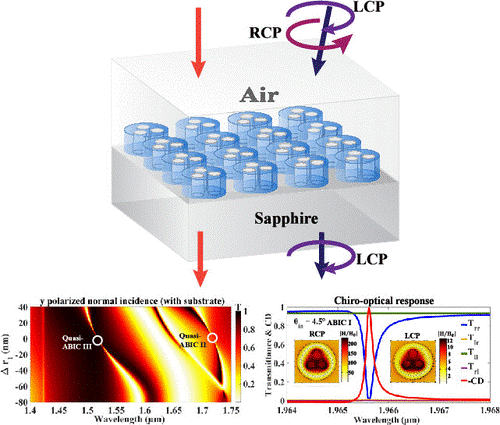
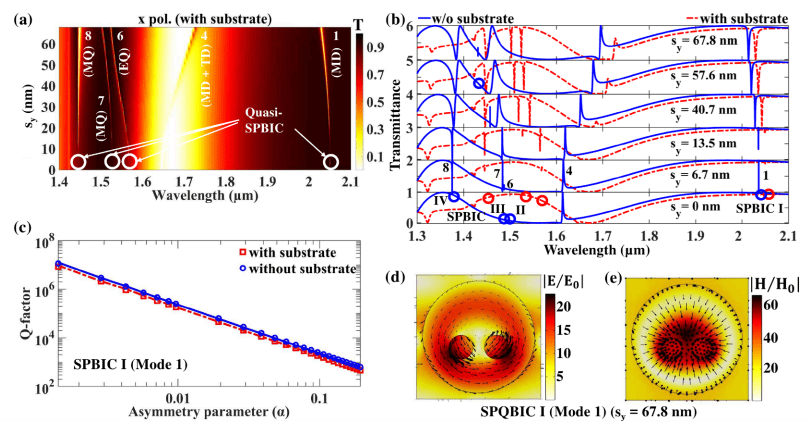
. In another study, COMSOL simulations enabled the design of dielectric metasurfaces supporting accidental bound states in the continuum (BICs) for ultra-high-Q chiral sensing. By coupling electromagnetics, nanoscale geometry optimization, and chiroptical analysis, the platform demonstrated near-perfect circular dichroism and strong field confinement for next-generation sensing and bioimaging applications.
At the heart of many advanced photonic technologies lies a complex multiphysics challenge: understanding how optics, electromagnetics, thermal effects, and materials interact simultaneously inside a single device. Without simulation, solving such problems experimentally would require enormous time, cost, and repeated prototyping.
Alina Karabchevsky, PhD, MSc, BSc
Professor
Optica Fellow
School of Electrical and Computer Engineering
Director, Integrated Photonic Circuits Centre
Chair, Women in Engineering (WIE) Affinity Group, IEEE Israel Section
Ben-Gurion University of the Negev
 03-9629621
  office@numerical.co.il
  נומריקל
  קבוצת קונוויזור דיגיטל